
Alternative Dispute Resolution

A newly acquired ADR service needed to be integrated into CasinoReviews as a credible, regulatory compliant product. I designed the full MVP end to end, as the sole designer on the team, working directly with developers within the constraints of Auth0, Zendesk, and a proprietary CMS.

Alternative Dispute Resolution

A newly acquired ADR service needed to be integrated into CasinoReviews as a credible, regulatory compliant product. I designed the full MVP end to end, as the sole designer on the team, working directly with developers within the constraints of Auth0, Zendesk, and a proprietary CMS.

COMPANY

Blexr

Role

UX/UI Designer

COMPANY

Blexr

Role

UX/UI Designer

COMPANY

Blexr

Role

UX/UI Designer

Player portal

Private, secure dispute tracking and communication

Content autonomy

Cases managed without developer involvement

Case archive

7,000+ resolved cases made publicly searchable

The context

The context

A regulatory service that had to feel like a product

Blexr acquired The Pogg, a UKGC and MGA-accredited Alternative Dispute Resolution service, to integrate it into CasinoReviews. The goal was to position it as a trust and regulatory component within the product, not a separate tool but a native part of the platform.

ADR in the online casino space is genuinely complex. The service has legal authority to deliver binding outcomes, which made CasinoReviews the only affiliate site operating at that level of regulatory legitimacy. That distinction needed to come through in the design without making the experience feel bureaucratic or inaccessible to users who are already in a frustrating situation.
The Research

The Research

What the research involved

The most important research step was a series of in-depth interviews with the UKGC and MGA-accredited administrator who oversees the ADR process. These conversations were essential for understanding the legal constraints, the internal operations, and the specific nuances of how cases are handled, information that could not have come from user research alone.

What came through clearly was a tension that had to sit at the centre of the design: users needed transparency about the process, but also complete confidentiality about their specific case. Those two things had to coexist in the same experience.

A service blueprint was the tool that made the constraints visible and designable. It mapped legal requirements, technical capabilities, and user needs together, which allowed me to make informed decisions about navigation, user journeys, and CMS component structure before touching a single screen.
The solution

Two experiences with different jobs

The MVP was structured around two distinct areas with very different jobs.

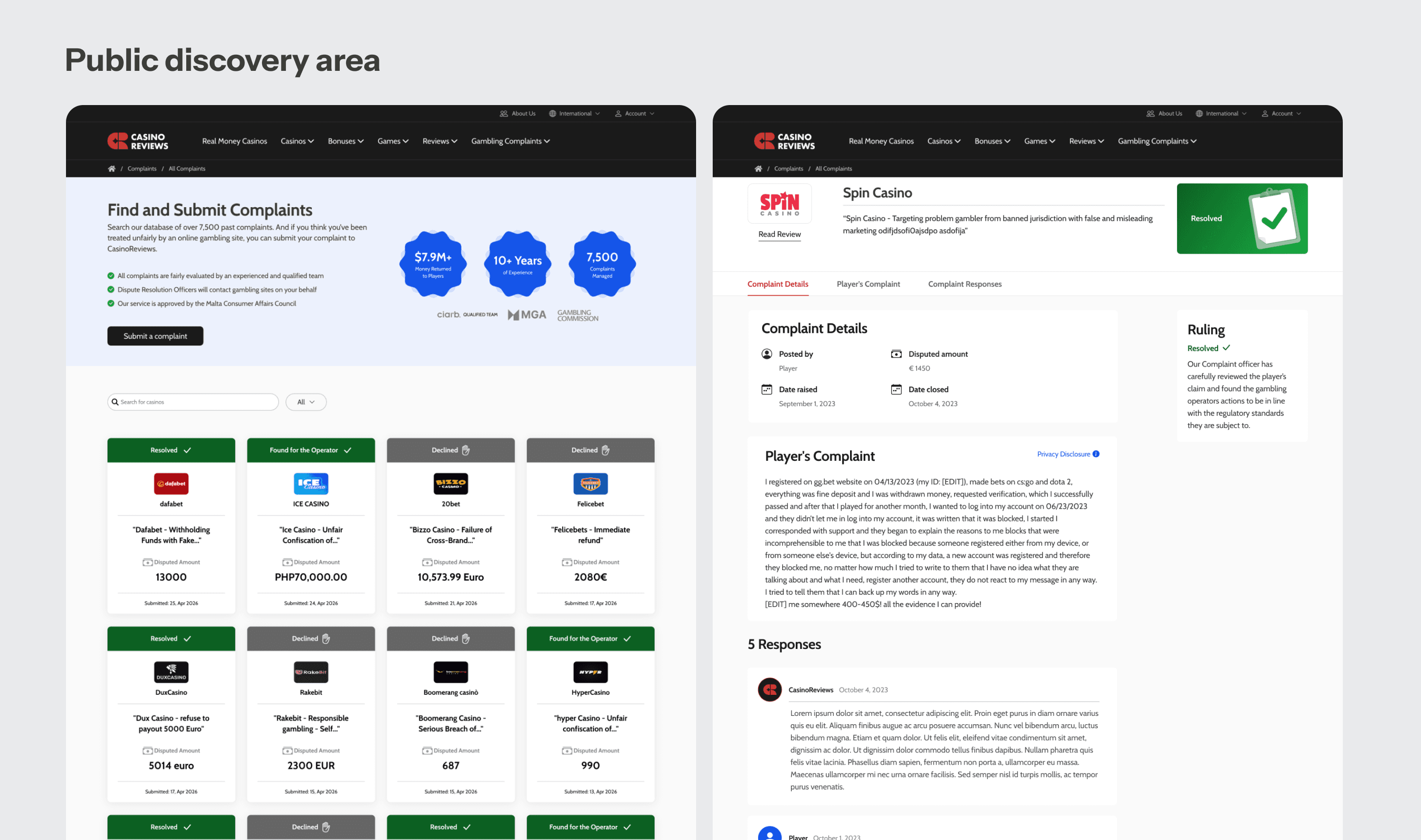
The public discovery area needed to communicate what ADR is, why it matters, and why CasinoReviews has the authority to offer it, clearly enough that a user in dispute could understand it without legal knowledge. This included a searchable archive of anonymised resolved cases, which served both as social proof and as a reference for users evaluating whether to submit a complaint.

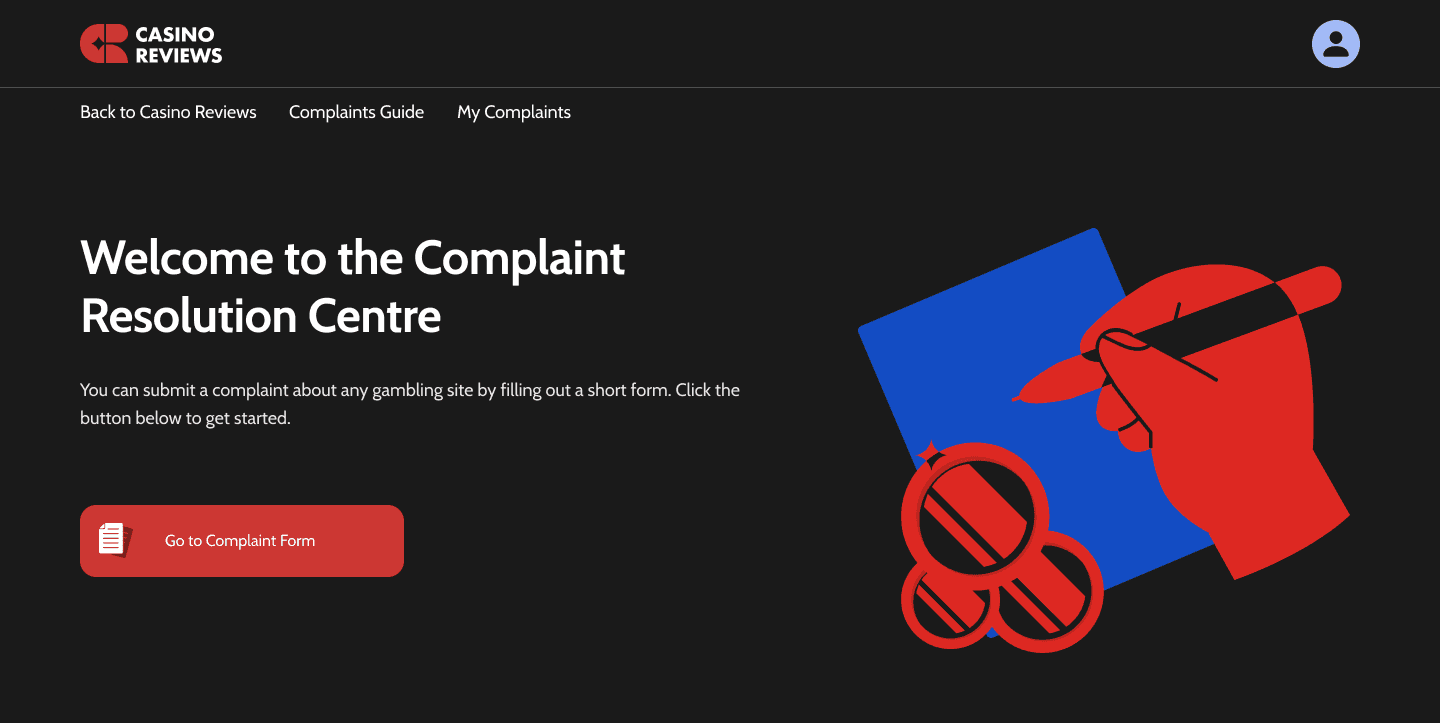
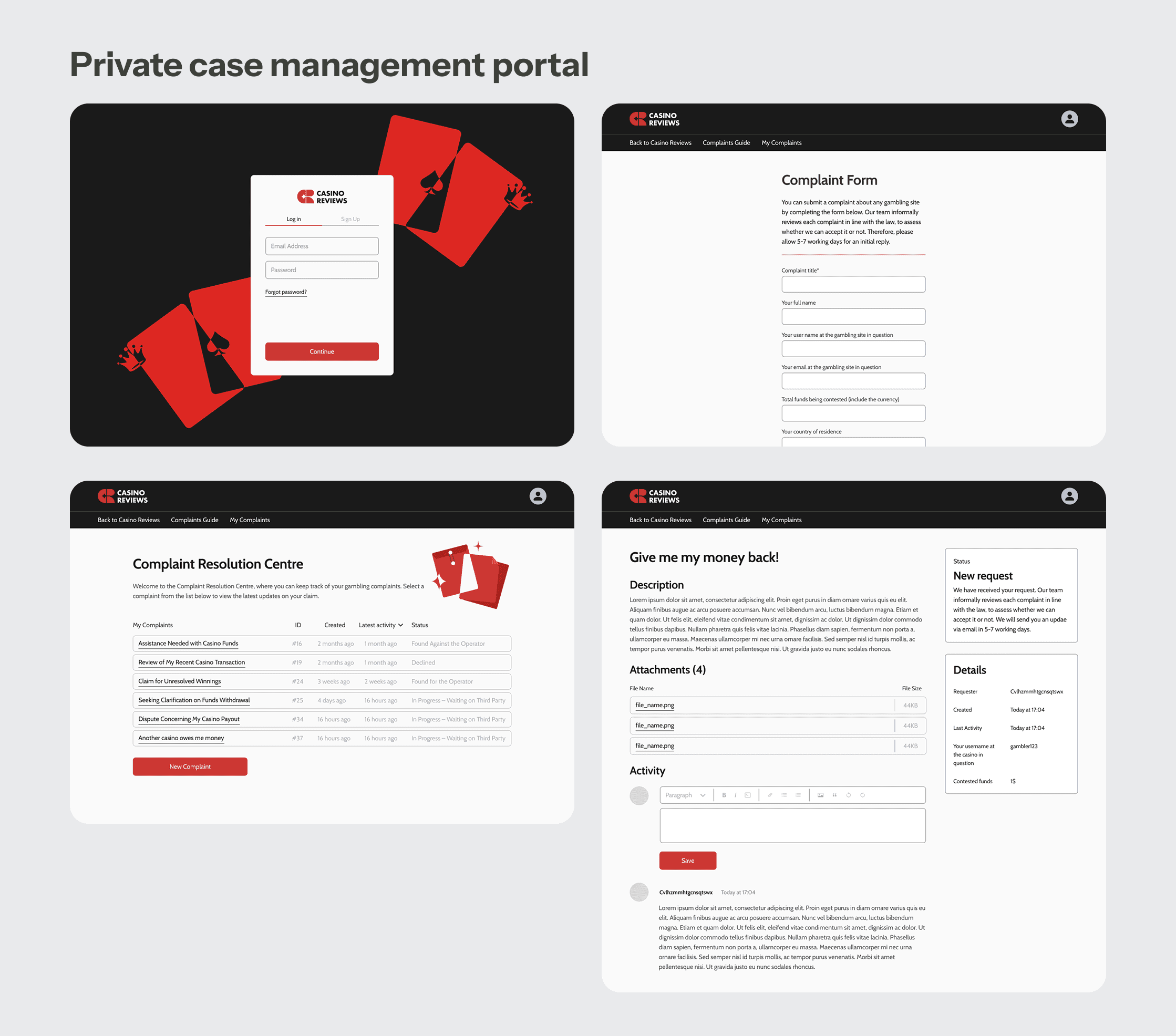
The private case management portal was a different problem entirely. Secure login via Auth0, complaint submission, and two-way communication with case handlers through Zendesk. Each of these third-party tools dictated constraints that had to be designed around rather than through.

The approach

Designing within constraints

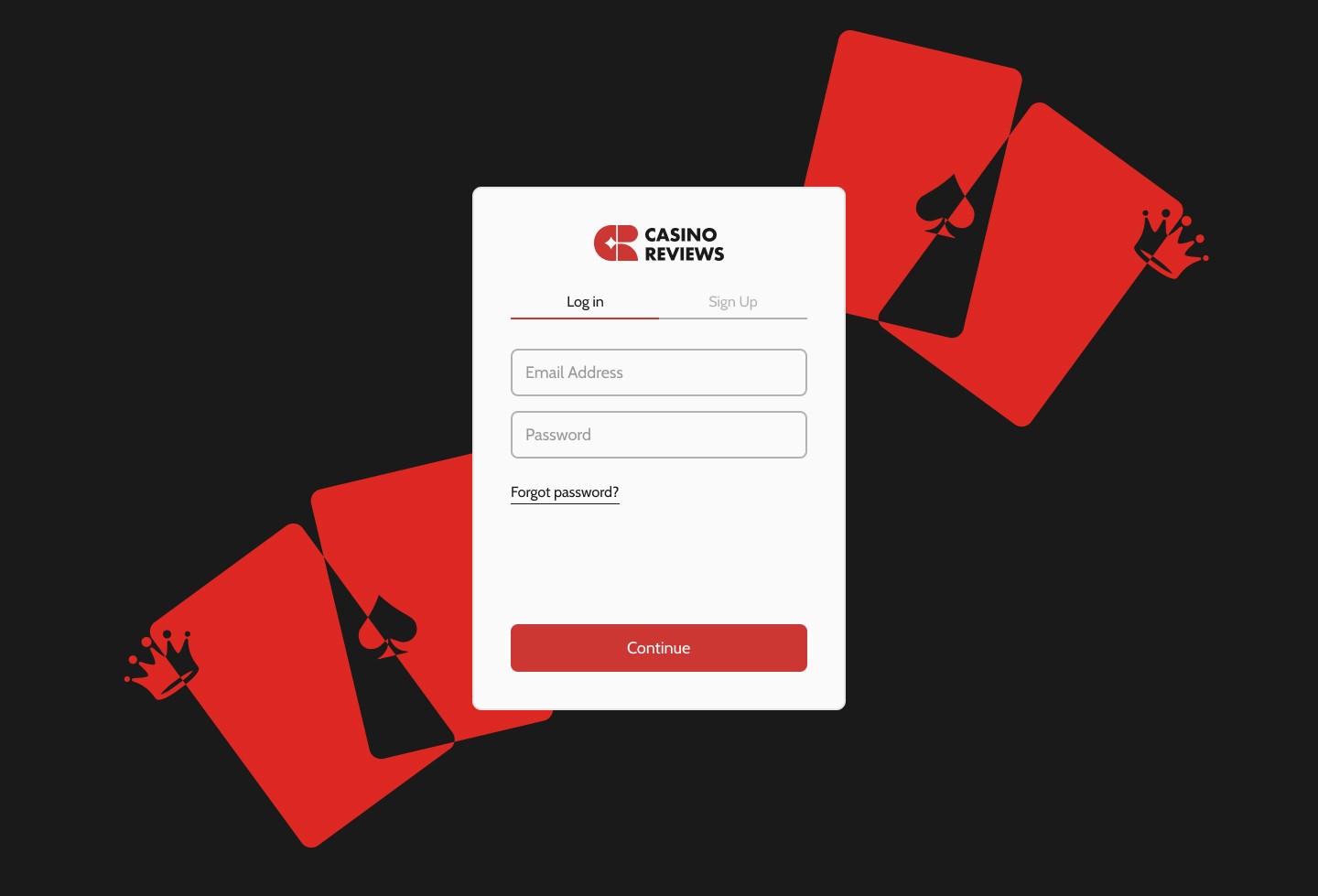
Auth0 controlled the visual and functional structure of login and registration. Zendesk shaped the case management experience. The interface also had to comply with the CasinoReviews global design system. None of these were negotiable.

Working within three overlapping constraint systems meant that early and continuous collaboration with developers was not optional. We explored customisation opportunities and technical workarounds together from the start, which meant that by the time screens needed to be built, the feasibility questions were already answered.

The response to these constraints was modular UI components designed to accommodate third-party limitations without exposing them to the user. The interface had to feel coherent and trustworthy even where the underlying system was fragmented.

The outcome

What the MVP delivered

Over 7,000 complaints were migrated into the new searchable case archive. The release established CasinoReviews as the only affiliate platform with accredited ADR authority, a regulatory positioning that no competitor in the space holds.

Takeaway

What this project makes visible

Regulatory UX does not have to feel regulatory. The challenge in this project was designing something that communicated legal credibility without alienating users who were already in a stressful situation. Transparency and clarity were the tools, not legal language and bureaucratic structure.

Working in a cross-functional team with real technical constraints changes how decisions get made. There is no design review process to fall back on. Every decision needs to be defensible on its own, and that is only possible when the relationship with developers is built before the constraints become problems.

The solution

Two experiences with different jobs

The MVP was structured around two distinct areas with very different jobs.

The public discovery area needed to communicate what ADR is, why it matters, and why CasinoReviews has the authority to offer it, clearly enough that a user in dispute could understand it without legal knowledge. This included a searchable archive of anonymised resolved cases, which served both as social proof and as a reference for users evaluating whether to submit a complaint.

The private case management portal was a different problem entirely. Secure login via Auth0, complaint submission, and two-way communication with case handlers through Zendesk. Each of these third-party tools dictated constraints that had to be designed around rather than through.

The solution

Two experiences with different jobs

The MVP was structured around two distinct areas with very different jobs.

The public discovery area needed to communicate what ADR is, why it matters, and why CasinoReviews has the authority to offer it, clearly enough that a user in dispute could understand it without legal knowledge. This included a searchable archive of anonymised resolved cases, which served both as social proof and as a reference for users evaluating whether to submit a complaint.

The private case management portal was a different problem entirely. Secure login via Auth0, complaint submission, and two-way communication with case handlers through Zendesk. Each of these third-party tools dictated constraints that had to be designed around rather than through.

The approach

Designing within constraints

Auth0 controlled the visual and functional structure of login and registration. Zendesk shaped the case management experience. The interface also had to comply with the CasinoReviews global design system. None of these were negotiable.

Working within three overlapping constraint systems meant that early and continuous collaboration with developers was not optional. We explored customisation opportunities and technical workarounds together from the start, which meant that by the time screens needed to be built, the feasibility questions were already answered.

The response to these constraints was modular UI components designed to accommodate third-party limitations without exposing them to the user. The interface had to feel coherent and trustworthy even where the underlying system was fragmented.

The approach

Designing within constraints

Auth0 controlled the visual and functional structure of login and registration. Zendesk shaped the case management experience. The interface also had to comply with the CasinoReviews global design system. None of these were negotiable.

Working within three overlapping constraint systems meant that early and continuous collaboration with developers was not optional. We explored customisation opportunities and technical workarounds together from the start, which meant that by the time screens needed to be built, the feasibility questions were already answered.

The response to these constraints was modular UI components designed to accommodate third-party limitations without exposing them to the user. The interface had to feel coherent and trustworthy even where the underlying system was fragmented.

The outcome

What the MVP delivered

Over 7,000 complaints were migrated into the new searchable case archive. The release established CasinoReviews as the only affiliate platform with accredited ADR authority, a regulatory positioning that no competitor in the space holds.

The outcome

What the MVP delivered

Over 7,000 complaints were migrated into the new searchable case archive. The release established CasinoReviews as the only affiliate platform with accredited ADR authority, a regulatory positioning that no competitor in the space holds.

Takeaway

What this project makes visible

Regulatory UX does not have to feel regulatory. The challenge in this project was designing something that communicated legal credibility without alienating users who were already in a stressful situation. Transparency and clarity were the tools, not legal language and bureaucratic structure.

Working in a cross-functional team with real technical constraints changes how decisions get made. There is no design review process to fall back on. Every decision needs to be defensible on its own, and that is only possible when the relationship with developers is built before the constraints become problems.

Takeaway

What this project makes visible

Regulatory UX does not have to feel regulatory. The challenge in this project was designing something that communicated legal credibility without alienating users who were already in a stressful situation. Transparency and clarity were the tools, not legal language and bureaucratic structure.

Working in a cross-functional team with real technical constraints changes how decisions get made. There is no design review process to fall back on. Every decision needs to be defensible on its own, and that is only possible when the relationship with developers is built before the constraints become problems.